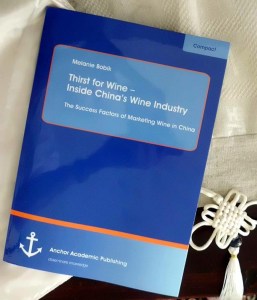
 I am proud and happy to announce the publication of my book “Thirst for Wine – Inside China’s Wine Industry” which is available in selected bookstores as well as on Amazon, Dussmann Berlin, Barnes&Noble and many more.
The foundation for this book was laid by my MBA thesis which I wrote in the city of Zhuhai in South China. Published first as an eBook, the thesis got that popular on the internet that a renowned publishing house in Hamburg, Germany, Diplomica Publishing, brought it to the market as a hardcover book in a revised version.
Red Wine Consumption in China
Grape wine in China, especially from countries outside China, is considered to be a luxury good. Not only because of the high price, but also because it is not as easily available as in the “West”. It may be easy for Europeans to buy wine from Chile, Australia or the US as it is available in supermarkets with a wide product range to choose from. But not so in China – wine consumption has only rocketed in recent years.
The Chinese palate prefers red wine and in fact, China has become the biggest consumer of red wine worldwide. Until recently it was mainly France to deliver their red gold to the Far East, especially Bordeaux.
However, more than 80 percent of red wine consumed in the country comes from their own domestic wine yards. In fact, today China is the fifth largest producer of red wine, ranking after France, Italy, Spain and the US. Their local wine production has increased enormously in the past years.
Red Wine for Health
Why red? That has a lot to do with the Chinese belief of red being a color of good luck, health and all things positive. Red underwear is most common in the stores, wedding banquets are decorated with red ribbons, money is given as a gift in the popular “hong bao”, the red envelope, and the Chinese national flag shines in bright red.
The prices for foreign wines, especially those for French red wines such as Bordeaux, have always been much higher than in Europe. Whereas in the past two decades it was appropriate to choose the most expensive French wines for official banquets, upper-class weddings or as prestigious gifts, China has seen a change in attitude towards luxury goods. The government has preached austerity to their people, with the consequence of massive savings on governmental spendings for official events and the fight against corruption.
Wine in China – Domestic Wine for the Middle-Class
However, wine consumption as such won´t decrease in China. Rather consumption behavior is changing. Red wine consumption will continue to outweigh the one for white wine, but domestic wines rather than imported ones will dominate the wine industry in China. Not only because of the logistic challenges that Covid-19 restrictions impose and certain regulations on wine imports that may allege to protectionism, but also because of the Chinese consumers themselves. Wine wise, they will become more and more sophisticated and will develop their own sense and taste of wine which in the end will make them choose the wine they most like. And this does not necessarily mean that their choice will be an expensive wine from abroad.
The thirst for wine continues, but wine traders and producers from outside China will have to manage a sharp pricing policy, extraordinarily good distribution contacts and a locally adapted marketing strategy in order to participate in this dynamic market.
 Marketing in China: What´s New?